Quick answer: West Texas dust storms deposit fine silt into gutters, which compacts into a mud-like layer once mixed with even small amounts of rain. Over time this weight causes sagging, fastener failure, and accelerated seam corrosion. Inspect and clean your Midland/Odessa gutters at least twice yearly — once after spring dust season and once after fall leaf drop.
If you've lived in Midland or Odessa for more than one spring, you know the sight: the horizon turns brown, the wind howls, visibility drops to a few hundred feet, and an hour later every exterior surface of your home is coated in fine, gritty dust. What most homeowners don't think about is what happens next — specifically, inside your gutters.
Dust storms are one of the most under-appreciated causes of gutter failure in the Permian Basin. This guide explains exactly how they damage gutters, what to watch for, how to clean up afterward, and whether gutter guards actually help.
The 4 ways dust storms damage gutters
1. Compacted silt adds serious weight
A typical Midland dust storm can deposit a noticeable layer of fine silt along horizontal surfaces — and your gutters are horizontal surfaces. Dry dust alone isn't catastrophic, but once it mixes with the next rain, that silt becomes a dense, mud-like material that clings to gutter walls and resists normal water flow.
A 100-foot gutter run caked with compacted silt and debris can hold dozens of pounds of extra weight. Over time this stresses fasteners, pulls hangers out of fascia, and causes visible sagging.
2. Fine dust accelerates corrosion at seams
On sectional gutters, dust settles into slip-joint seams where sealant protects the connection. Once silt wedges into these joints, it holds moisture against the sealant and accelerates its breakdown. That's part of why sectional gutters fail so much faster than seamless in the Permian Basin.
3. Downspouts clog from the inside
Water carries compacted silt toward the downspout, where it accumulates at elbows and bottom sections. A downspout that worked fine before dust season can clog entirely after one or two storm cycles.
4. Wind-borne debris dents and tears
Dust storms aren't just dust. Sustained winds of 30–50+ mph carry tumbleweeds, mesquite branches, cottonwood pods, and loose yard debris. Large debris impacting gutters can dent aluminum, bend downspouts, and occasionally tear sections loose from fascia.
Warning signs after a dust event
- Visible sagging — any dip, droop, or pull-away from the fascia is a problem.
- Dust streaks on the fascia below — water is overflowing and carrying silt down.
- Water stains on siding — tells you the gutter overflowed during the last rain.
- Mulch displacement under downspouts — downspout isn't extending far enough.
- Pooling near the foundation — any standing water within 3 feet of the house.
- Separated corners or miters — 90-degree corners should be tight and leak-free.
- Paint bubbling below gutters — indicates a slow leak has been saturating the fascia wood.
Post-storm cleaning: step-by-step
What you'll need
- A sturdy extension ladder rated for your height + weight
- A gutter scoop or a small plastic trowel
- A garden hose with a spray nozzle
- Work gloves and safety glasses
- A dust mask or N95 respirator (fine silt becomes airborne)
- A 5-gallon bucket on a ladder hook
- A partner to spot the ladder (non-negotiable)
The process
- Wait for safe conditions. Wind under 15 mph and dry gutters.
- Inspect from the ground first. Look for sagging, streaks, and overflow signs.
- Start at the downspout end. Work your way away from the downspout.
- Scoop the compacted layer into your bucket. Do not drop in landscaping.
- Flush with water. Water should flow cleanly to the downspout.
- Clear the downspout. Tap gently; if clogged, disconnect bottom elbow and flush from top.
- Check seams at corners for silt stains or seepage.
- Extend downspouts at least 4–6 feet from foundation.
If your home is two stories or you're not confident on a ladder, professional gutter cleaning runs $100–$250 for most Midland homes.
Gutter maintenance schedule for West Texas
| Season | What to Do | Why |
|---|---|---|
| Late Spring (May–June) | Full cleaning, inspect for dust storm damage | Dust season peaks Feb–May; monsoons start July |
| Summer (July–Aug) | Spot-check after major storms for hail and wind damage | Peak thunderstorm and hail season |
| Fall (October–November) | Second full cleaning, clear leaves and mesquite debris | Cottonwood and mesquite drop; clear before winter |
| Winter (Dec–Feb) | Ground-level inspection only | Occasional freezes can crack seams |
Do gutter guards actually help against dust?
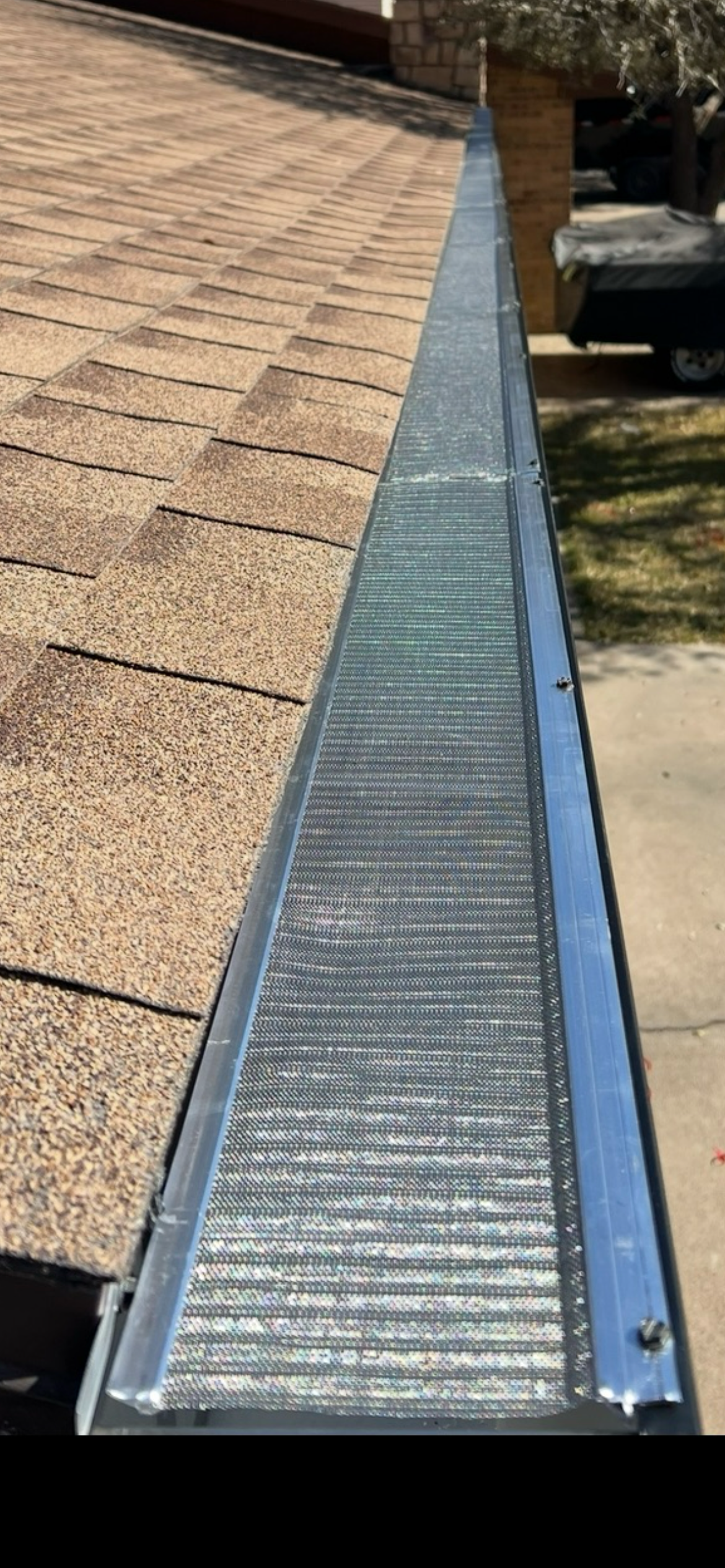
Micro-mesh gutter guards are the most effective option against fine West Texas dust. The small mesh openings (around 50 microns) prevent silt from entering the gutter trough while still allowing water to flow through.
| Guard Type | Dust Protection | Cost per Foot |
|---|---|---|
| Micro-mesh (stainless) | Excellent | $8–$12 |
| Screen (aluminum) | Moderate — lets fine dust through | $3–$5 |
| Foam insert | Poor — dust packs into foam | $2–$4 |
| Reverse curve | Moderate — dust can wash over | $6–$10 |
| Brush | Poor — dust settles between bristles | $2–$4 |
For a full breakdown, see Are Gutter Guards Worth It in West Texas?
Which West Texas trees make it worse
- Mesquite. Small leaves and seed pods drop year-round. Slip through most screens and combine with dust into dense clogs.
- Cottonwood. Drops fluffy seed masses in late spring that mat together once saturated.
- Pecan. Large leaves, nutshells, and catkins. Nutshells can physically block downspout elbows.
- Oak (live oak, shin oak). Less common but still drops leaves and acorns.
Ready to Get Started?
Get a free quote for your gutter project today.
Frequently Asked Questions
How often should I clean my gutters in Midland/Odessa?
Clean your gutters at least twice per year in Midland and Odessa — once in spring after dust storm season ends and once in fall after leaf drop.
Can dust storms actually damage gutters?
Yes. Dust storms deposit fine silt that compacts into a mud-like layer once mixed with rain, adding significant weight to gutters and eventually causing sagging, fastener failure, and accelerated corrosion at seams.
Do gutter guards work against dust?
Micro-mesh gutter guards are the most effective against fine dust because the small mesh openings prevent silt accumulation inside the gutter trough.
What trees cause the most gutter clogs in Midland?
Mesquite (small leaves and pods), cottonwood (fluffy seed masses in late spring), and pecan (large leaves and nutshells) are the biggest gutter-clogging offenders in Midland.
Is it safe to clean gutters myself after a dust event?
Only in calm conditions (wind under 15 mph) with a stable ladder and a partner. Fine dust inhalation is a real concern — wear a dust mask or N95 respirator.